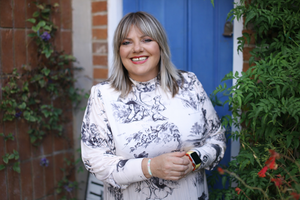
I spend my working life helping business owners feel more confident on LinkedIn. Profiles, content, strategy: it's what I do, day in, day out.
So you'd think my own profile would be spot on, right?
Well. I took a proper look at my About section this week and realised it was doing a perfectly decent job of telling people what I do. But it wasn't really telling them why I do it, or what I believe about LinkedIn that makes my approach different.
It was fine. But fine isn't the same as good.
What prompted the rethink
Two recent posts from Emily Penny (Becolourful) landed at exactly the right moment. Emily is a leading voice in brand positioning and strategy and she's someone I genuinely rate when it comes to thinking about how businesses communicate.
In her "Four Levels of Copywriting" framework, she makes the case that most business writing sits at the first two levels: Information (the facts about what you do) and Proposition (showing the value). Both are important. But the brands that people actually remember and talk about push further into two more levels: Point of View (having an angle, a belief, something to say) and Imagination (the memorable language and ideas that make you unmistakably you).
I looked at my About section and had to be honest with myself: I was sitting comfortably at levels one and two. Clear, warm, professional. But where was my point of view? Where was the bit that would make someone think "yes, that's exactly how I feel about LinkedIn too"?
What I changed (and why)
I won't walk you through every line (you can read the finished version on my profile), but here's the thinking:
I led with what I believe, not what I do. My old About opened with my daily activity. The new one opens with a statement about how I think LinkedIn should work. That's a deliberate choice: it immediately signals what I stand for, and the people who share that view will keep reading.
I added “imagery” that sticks. One of my past clients, Ros Thompson, once described working with me as 💡 "finding my way around the LinkedIn world with the light on instead of fumbling around in the dark." That's such a vivid picture, and it captures the transformation better than anything I could write about myself. So I borrowed it.
I let my clients' language do the heavy lifting. The word "SuperHelpful" keeps appearing in my testimonials. Not because I've asked people to say it; they just do. So rather than leading with it as a brand statement, I let it land naturally: "My clients call my approach SuperHelpful™️ — I'll take that."
I kept what was already working. My community involvement in Chichester (the Cinema, Last Friday Club, RUME2) was already in there and it's genuinely differentiating. Not many LinkedIn specialists can point to over a decade of local community building. It stays.
Why I'm bothering to tell you this
Because if you're reading this thinking "I really should look at my own LinkedIn profile but I keep putting it off" — I get it. I am it. The person who helps other people with their profiles just had to redo her own.
Here's what I'd encourage you to do: go and read your About section right now. Not to tear it apart, but to ask yourself one question:
Does it tell people what you believe, or just what you do?
If it's mostly the second one, you're not alone. Most profiles are. But that's also your opportunity, because most of your competitors won't bother going further.
Emily's framework gave me the nudge I needed. I've linked to both of her posts below; they're well worth a read.
And if you'd like a hand working through your own profile refresh, well... you know where to find me. I love a chat.
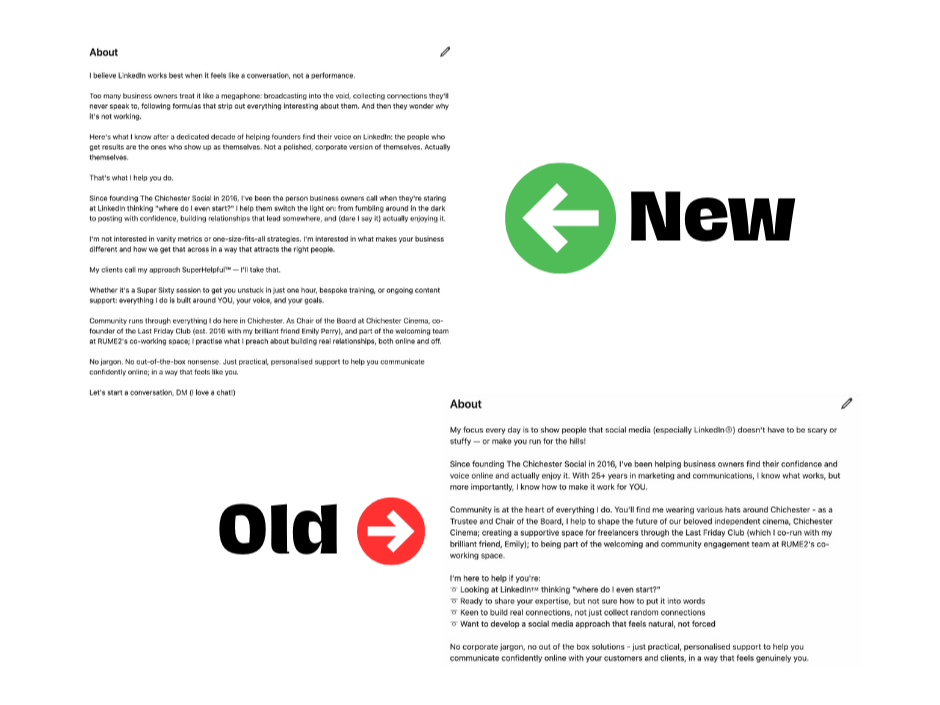
New vs Old About section on my LinkedIn Profile